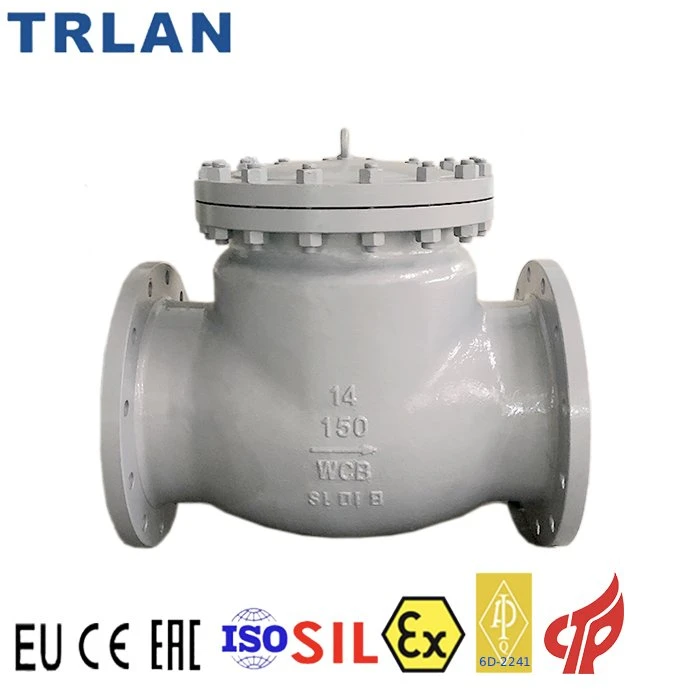
In modern fluid transportation and control systems, check valves are important automatic control devices mainly used to prevent reverse media flow and ensure the safe operation of pipeline equipment. With advantages such as automatic operation, no external power requirement, and reliable structure, check valves are widely used in industries including petroleum, natural gas, chemical processing, power generation, water treatment, and building water supply systems. Understanding the structural features of check valves helps maximize equipment performance and improve the safety and efficiency of fluid systems.
The main structure of a check valve consists of a valve body, valve disc, valve seat, spring, pin shaft, and sealing components. Different types of check valves may have different designs, but their basic operating principle is based on controlling media flow through the movement of the valve disc. When the medium flows in the designed direction, pressure pushes the valve disc open, allowing smooth flow. When the flow stops or reverse flow occurs, the valve disc automatically closes and forms a seal with the valve seat to prevent backflow.
The valve body is a key load-bearing component of a check valve. Its main function is to connect the pipeline and withstand internal pressure. According to different operating environments, valve bodies can be manufactured from materials such as cast iron, carbon steel, stainless steel, and alloy materials. Proper material selection improves pressure resistance and corrosion resistance, allowing check valves to operate reliably under various media conditions.
The valve disc is the core moving component of a check valve and directly affects opening and closing performance. A well-designed valve disc must provide smooth movement and reliable sealing. During operation, the valve disc responds quickly to changes in fluid pressure, enabling automatic opening and closing. Some high-performance check valves use lightweight disc designs to reduce opening pressure and improve response sensitivity.
The sealing structure is a critical part of check valve design. When the valve disc closes, it must maintain close contact with the valve seat to prevent media leakage. According to application requirements, check valves can use soft sealing or metal sealing structures. Soft sealing check valves provide excellent sealing performance and are suitable for general fluid applications, while metal sealing check valves offer stronger resistance to high temperatures, high pressures, and wear, making them suitable for demanding industrial conditions.
Check valve structures also feature strong diversity. According to different installation methods and operating requirements, check valves can be divided into lift check valves, swing check valves, butterfly check valves, and ball check valves. Lift check valves have a compact structure and fast response speed, making them suitable for small-diameter pipelines. Swing check valves provide strong flow capacity and low pressure loss, making them suitable for large pipeline systems. Butterfly check valves are lightweight, compact, and convenient for installation and maintenance.
In addition, modern check valve designs increasingly focus on energy efficiency and intelligent operation. By optimizing internal flow passages, fluid resistance can be reduced and system energy consumption can be lowered. By integrating intelligent monitoring devices, valve operating conditions can be monitored in real time, improving equipment management efficiency.
With the continuous improvement of industrial automation, check valve structures and manufacturing technologies are constantly being optimized. More reliable designs, higher-precision manufacturing processes, and advanced sealing technologies enable check valves to meet increasingly complex application requirements and provide long-term, safe, and stable operation support for industrial fluid control systems.